Five minutes. Two hands. One of the most studied strength measures in health research.
How hard you squeeze is not only about your hands. Grip strength has a strong association with total-body strength, and researchers have followed it in more than half a million adults.
In the PURE study, grip strength predicted death from any cause, and death from heart disease, more strongly than systolic blood pressure.
Add the test onto any of the following services
16%
Higher risk of death from any cause for every 5 kg of grip strength lost.
PURE study · 140,000 adults
500,000
Adults followed. Lower grip strength tracked with heart disease, lung disease and several cancers.
UK Biobank · The BMJ
~50%
Lower risk of death for people highest in both fitness and grip strength, compared with those lowest in both.
UK Biobank
10%
Left–right gap linked to a higher chance of difficulty with everyday tasks later in life.
18,000 older adults
Grip strength is also the first screening test for age-related muscle loss in the international guidelines, which flag low strength below 27 kg for men and 16 kg for women. Know your number well before you get there.
Grip strength is a marker, not a verdict. These studies show strong associations. They do not show that a weak grip causes illness.
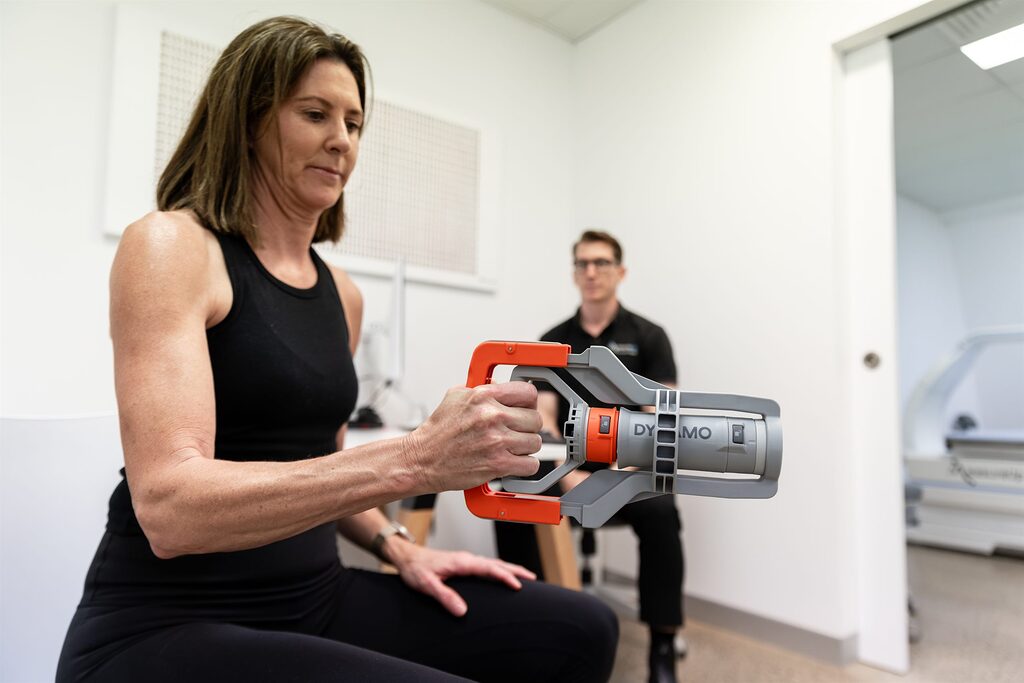
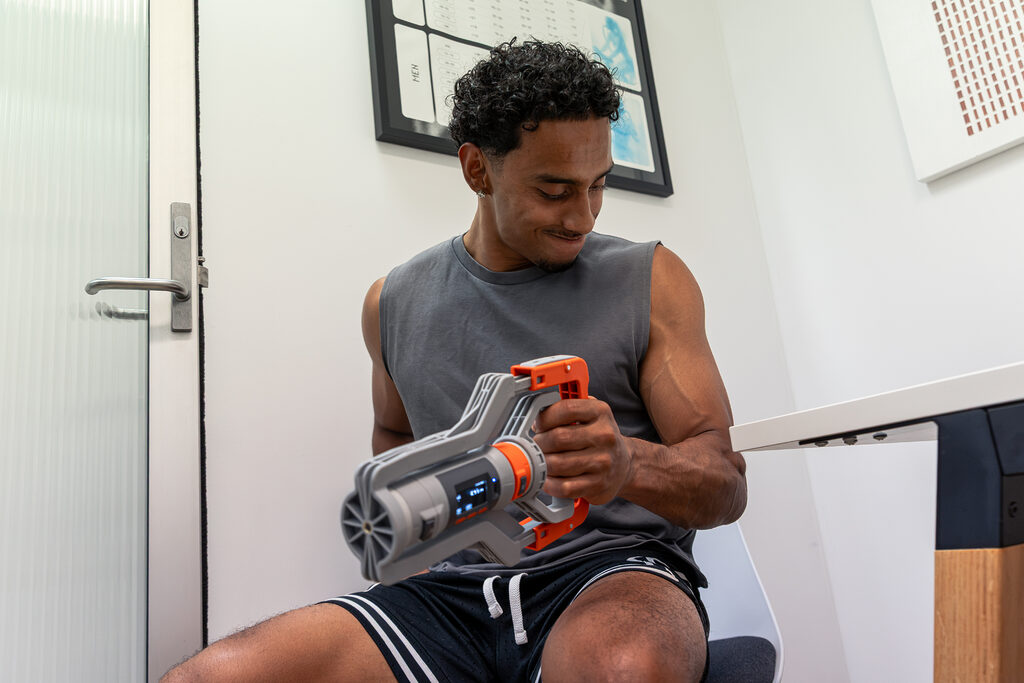
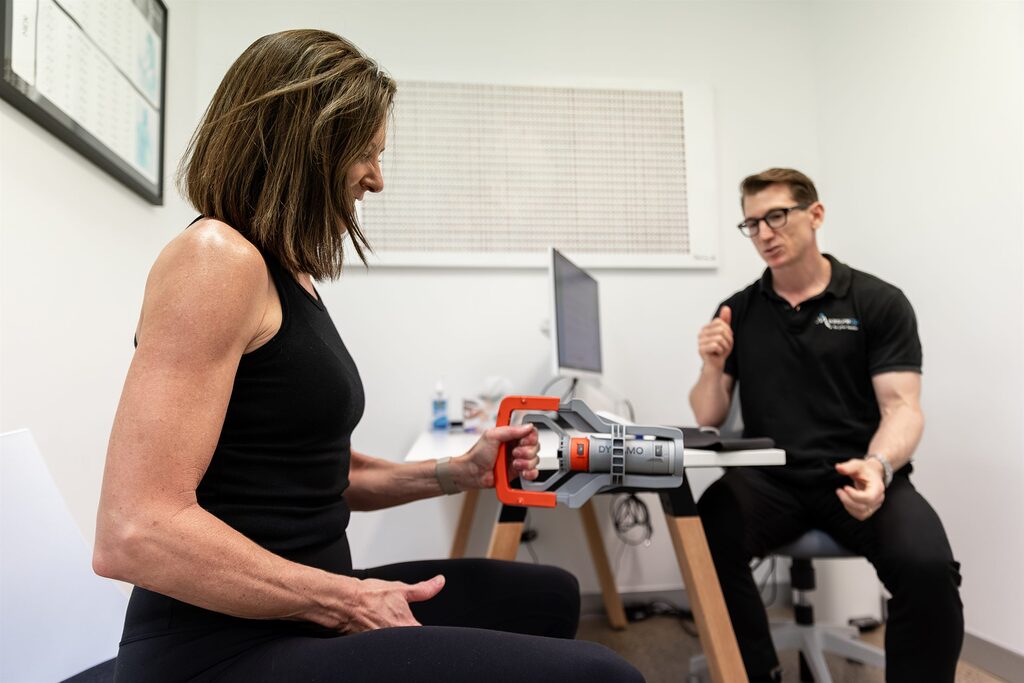
We use the VALD DynaMo, a digital dynamometer trusted by elite sport, sports medicine clinics and research groups. A standard dial gives you one reading. DynaMo records your whole squeeze as a force–time curve. You see how strong you are, how fast you produce force and how your two hands compare.
Strength fades with age. So does speed.
How quickly you build force decreases as you age. In a study of older women, it was the single best predictor of standing balance. In healthy older adults, both maximum grip strength and rate of force development were linked to agility. We measure both, so you get the full picture.
A quick, objective baseline for your strength, speed and left–right balance, benchmarked against people of your age and sex.
Add it to any of the eligible services listed above. It takes about 5 minutes inside your booked time. Select it under “Additional services” at checkout.
Add-on price. RRP $39.
The test takes about 5 minutes and happens inside your booked session.
To prepare
The test takes about 5 minutes and happens inside your booked session.
To prepare
Your grip strength report
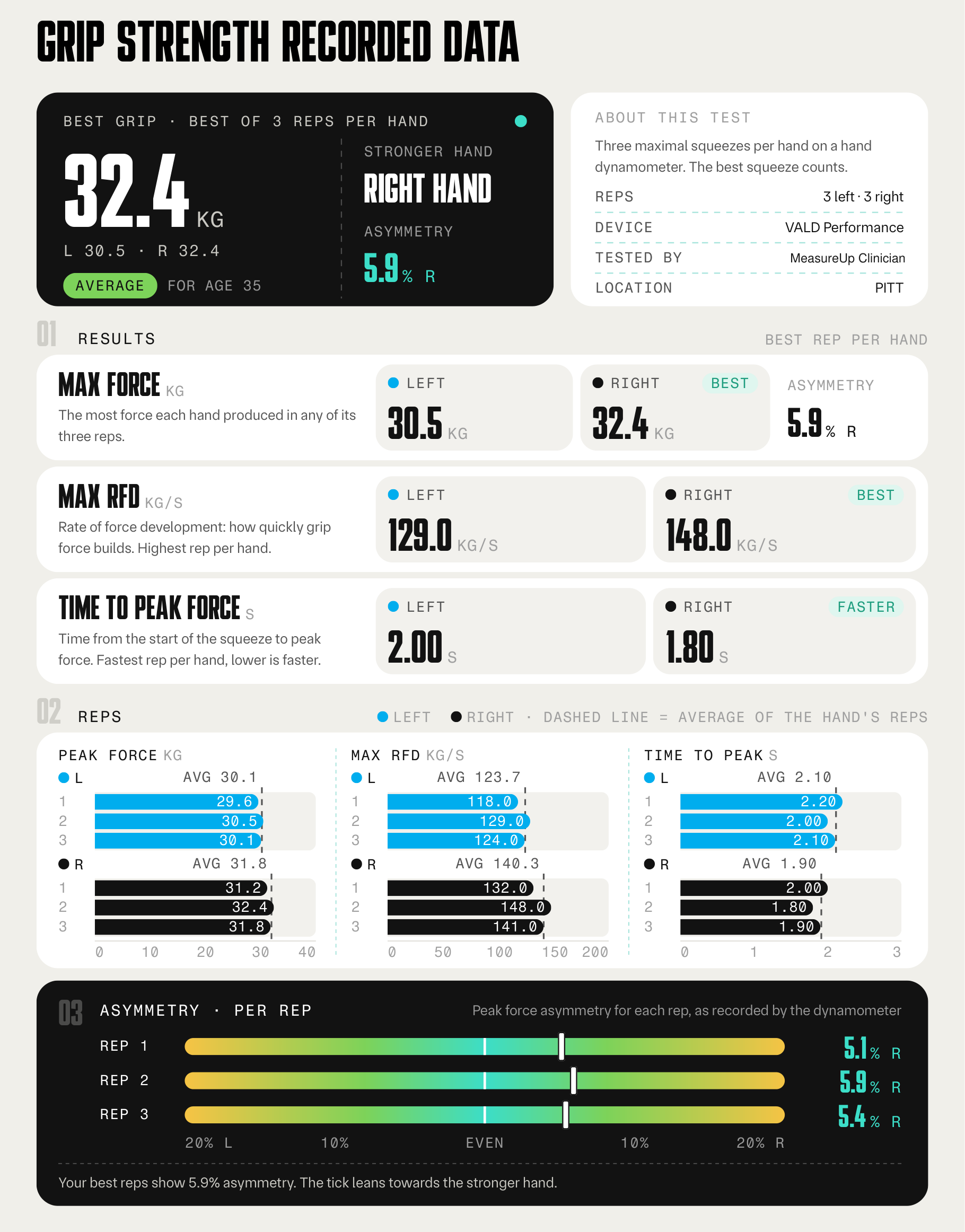
Your best grip leads the page: the strongest squeeze from three reps per hand, and the number used in the big health studies. The detail sits under it.
01
Results
Max force, max RFD and time to peak force for the best rep on each hand.
02
Reps
Every one of your six squeezes, charted against your own average.
03
Asymmetry
The left–right gap for each rep. A gap over 10% is worth watching.
04
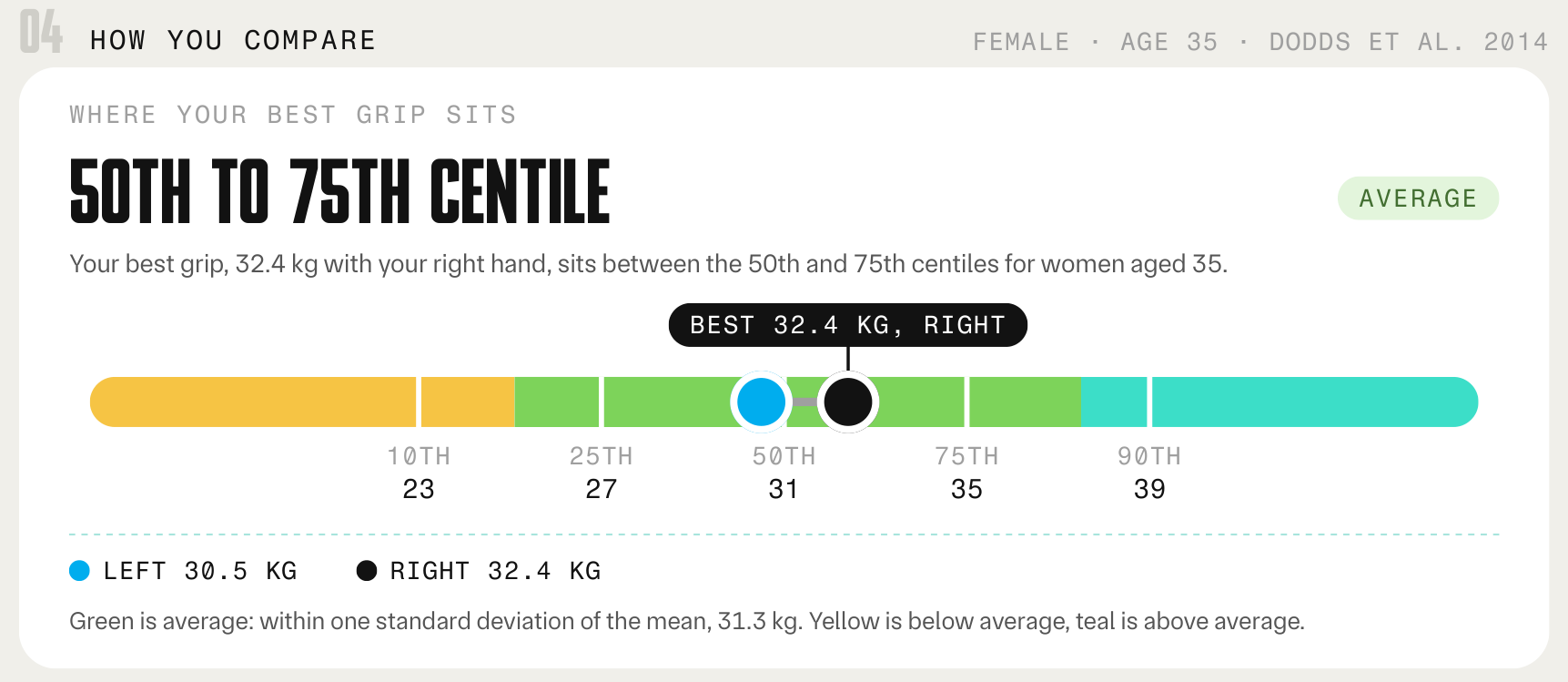
How you compare
Your centile against people of your age and sex, rated below average, average or above average.
05
Centiles
The full normative table for your sex, with your age row marked.
Frequently asked questions
Add it to DEXA + Consult, Starter Pack, RMR Test, RMR + DEXA + Consult, VO2 Max Test, Healthy Aging Assessment, Weight Loss Package or Endurance Package. Select it under “Additional services” at checkout and we fit it into your booked time. The Longevity Package already includes a grip strength test.
About 5 minutes.
Skip heavy gripping work (deadlifts, climbing) beforehand so we capture your true maximum. Tell us about any recent hand, wrist or elbow injury.
A report with your best grip, the max force for each hand, your left–right asymmetry, your rate of force development and your time to peak force. It shows every rep, and where you sit against normative data for your age and sex.
Every 12 weeks. It lines up well with your DEXA body composition scan.
No. Grip strength is a well-researched screening and tracking measure, but it does not diagnose any condition. If your number is lower than expected, we talk you through what it means and whether further assessment makes sense.
References