
If someone has ever told you that you have a “fast” or “slow” metabolism, they were most likely referring to your resting metabolic rate (RMR). But what does that actually mean—and how can you measure it accurately?
What is resting metabolic rate (RMR)?
Your resting metabolic rate is the amount of energy (kilojoules or calories) your body uses to stay alive while at rest. Even when you lie still, your body works constantly. It keeps your heart beating, your lungs breathing, and your brain functioning. As a result, all of these processes require energy—and that baseline energy use is your RMR.
Why your RMR matters
RMR accounts for the largest share of your daily energy use—about 60–75% for most adults (Müller & Bosy-Westphal, 2023). In other words, your body burns most of its energy without exercise.
Because of this, understanding your RMR helps you estimate how much energy your body actually needs. Therefore, it plays a key role in weight management, performance, and overall health.
Why everyone’s metabolism is different
There is no single “normal” resting metabolic rate. Instead, several factors influence it:
- Body size and muscle mass: More muscle increases energy use
- Age: Metabolism gradually slows over time
- Sex: Differences in body composition affect RMR
- Genetics and hormones: These control how your body uses energy
As a result, two people can follow the same diet or exercise plan and still see very different outcomes.
How to measure your resting metabolic rate
You can estimate RMR using formulas, but accurate testing provides much better insights.
Indirect calorimetry (metabolic testing)
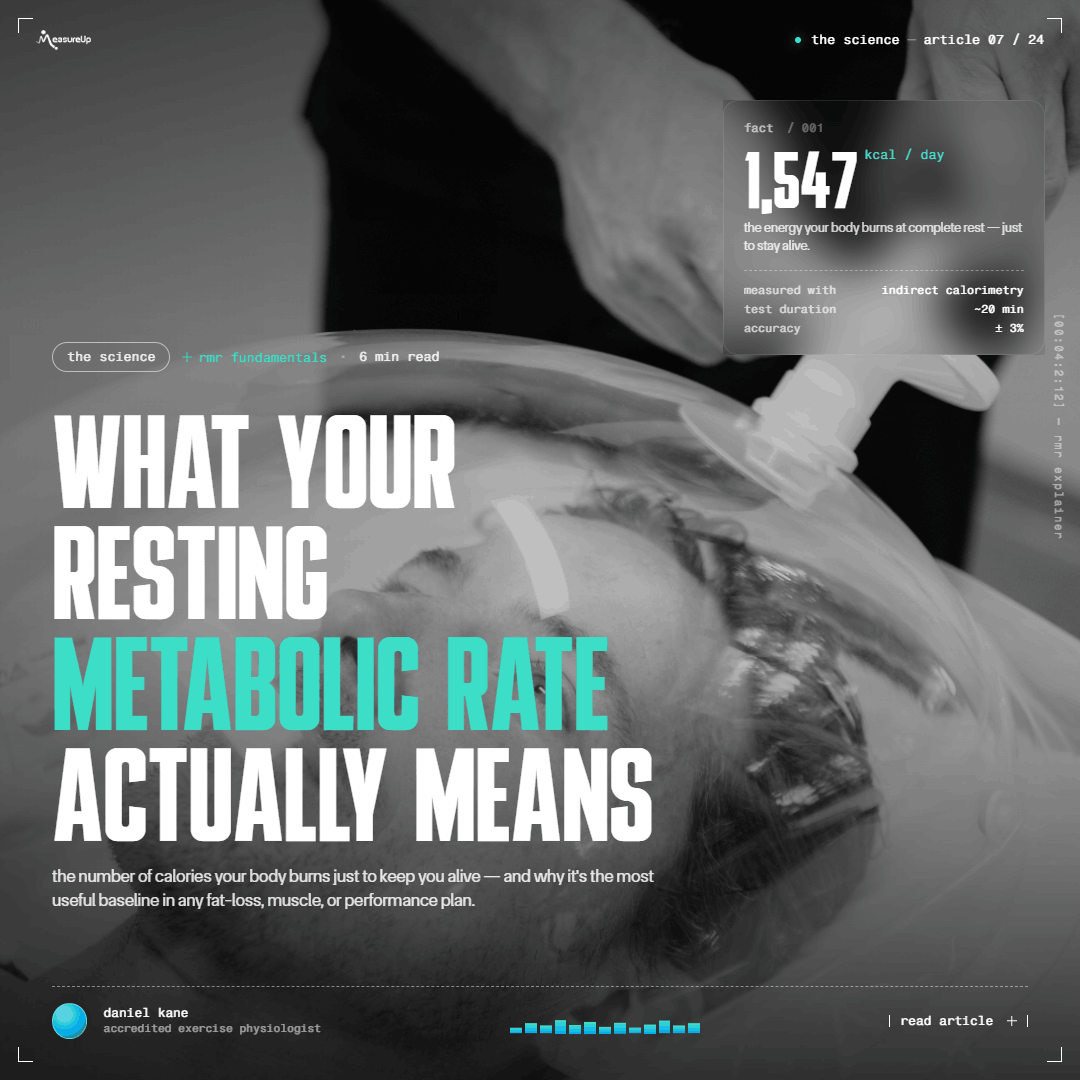
Metabolic carts use indirect calorimetry, which is considered the gold standard for measuring RMR. During the test, you lie still and breathe into a mask or hood. The system measures your oxygen intake and carbon dioxide output. Then, it calculates how much energy your body uses at rest (Haugen et al., 2007).
DEXA scans and metabolism insights
Although DEXA scans do not measure RMR directly, they analyse your body composition—muscle, fat, and bone mass. Since muscle burns more energy than fat, DEXA results help professionals interpret and predict your metabolic rate more accurately (Müller & Bosy-Westphal, 2023).
Together, these tools give you a far more personalised and precise understanding of your metabolism than estimates alone.
Common myths about metabolism
Many people blame weight gain on a “slow metabolism.” However, research shows that most people have an RMR within a normal range for their body size (McMurray et al., 2014). Instead, lifestyle factors—such as diet, physical activity, and sleep—usually have a greater impact.
In addition, your metabolism is not fixed. It can change over time due to muscle gain, ageing, illness, or long-term dieting.
Key takeaway: understand your baseline
Your resting metabolic rate represents your body’s baseline energy needs. Rather than labelling it as “good” or “bad,” you should view it as a starting point.
By using accurate tools like metabolic testing and DEXA scans, you can better understand your body. Consequently, you can make more informed decisions about your health, nutrition, and performance.
You can access these RMR and metabolism tests at MeasureUp clinics in Sydney and Brisbane.
References (APA style)
Haugen, H. A., Chan, L. N., & Li, F. (2007). Indirect calorimetry: A practical guide for clinicians. Nutrition in Clinical Practice, 22(4), 377–388.
McMurray, R. G., Soares, J., Caspersen, C. J., & McCurdy, T. (2014). Examining variations of resting metabolic rate of adults: A public health perspective. Medicine & Science in Sports & Exercise, 46(7), 1352–1358.
Müller, M. J., & Bosy-Westphal, A. (2023). Resting metabolic rate of individuals. Metabolites, 13(8), 926.