You’ve done the eight weeks. Trained hard, eaten well, been disciplined. Then you step on the scale and it’s barely moved, and every ounce of motivation goes with it.
Here’s the problem: the scale can’t tell the difference between losing three kilos of fat and losing three kilos of muscle. It has no idea whether the fat you’re carrying is sitting harmlessly under the skin or wrapped around your organs, quietly raising your metabolic risk. It just measures gravity pulling on your total mass, and it treats every kilo the same.
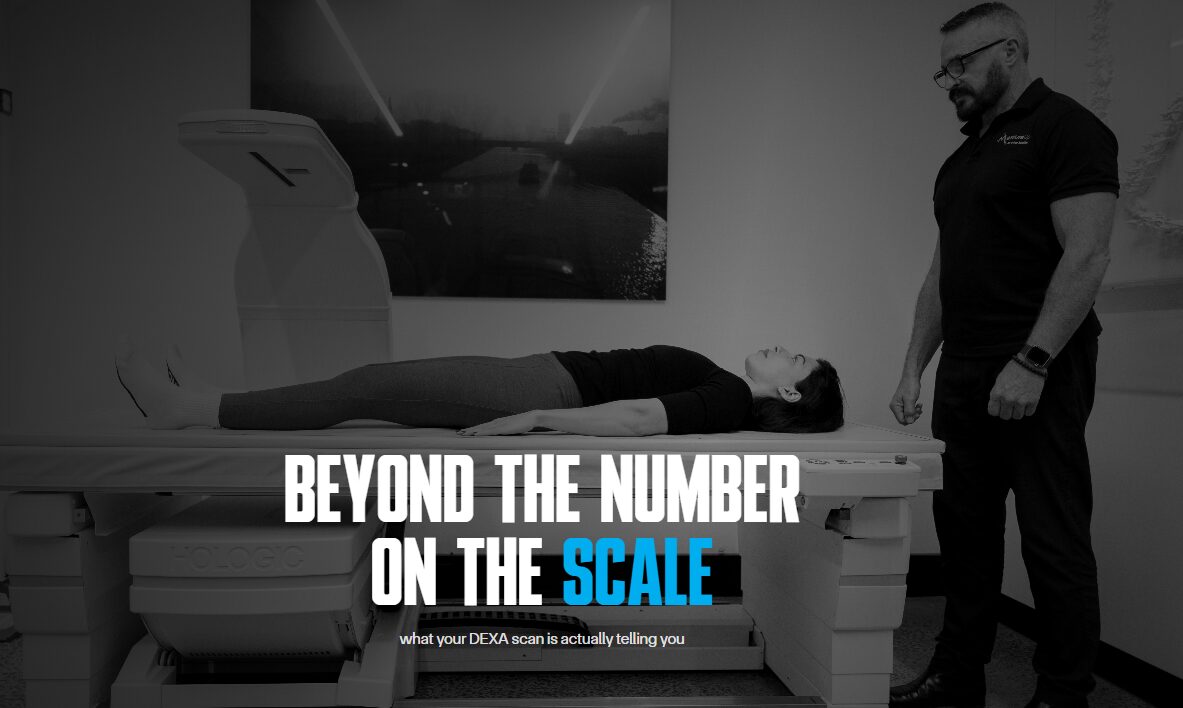
Your DEXA scan doesn’t have that problem. It splits your body into fat, lean tissue and bone, region by region, and that’s what makes it useful for something the scale never could: telling you what to actually change in your training and your nutrition.
Read the composition, not just the total
A DEXA report has three numbers that matter more than body weight ever will: fat mass, lean mass, and bone mass, each broken down by region. Put those together and a much more honest picture of “progress” appears.
Take the classic weight-loss scenario. Someone cuts calories, trains a bit, and the scale drops two kilos. Good news? Only if that loss came from fat. Without a breakdown of body composition, you’d never know whether the weight lost was from fat or muscle or both.
The segmental data offered by DEXA adds another layer most people never think to check. Left-versus-right asymmetries in arm or leg lean mass from favouring one limb during training are the kind of thing you or a trainer can act on directly. This allows you to determine if it is actually a training or perhaps nutritional issue.
Visceral fat may be more important than total fat
Of everything on the report, visceral adipose tissue (VAT), the fat around your organs rather than under your skin (subcutaneous fat), deserves the most attention, and it’s the one metric a set of scales will never give you.
Large population studies have consistently found that VAT predicts metabolic and cardiovascular risk independently of body weight or BMI. A cohort study of more than 1,500 adults tracked over several years found that rising visceral fat predicted the onset of metabolic syndrome even in people whose overall weight barely changed, while a separate longitudinal study of nearly 2,000 adults found each standard-deviation increase in visceral fat area was associated with a 50% higher risk of developing metabolic syndrome. Two people can carry an identical body fat percentage and have very different risk profiles depending on where that fat is located.
This is exactly why VAT belongs in the conversation with your GP or accredited practitioner, not just your trainer. If a scan shows visceral fat trending up despite a stable weight, that’s a nutrition and lifestyle signal worth acting on early.
Lean mass may inform you whether your protein intake is sufficient
If fat mass is the headline most people fixate on, lean mass is the number that should get equal billing, especially past your mid-thirties, when the natural rate of muscle loss begins to accelerate.
The research on protein intake and resistance training is remarkably consistent on one point: training alone isn’t enough to protect lean mass, and neither is protein alone. Reviews of older-adult populations point to roughly 1.4 g of protein per kilogram of bodyweight per day as the threshold needed to meaningfully support muscle protein synthesis when combined with resistance training, with the research also suggesting the benefit may plateau once daily intake climbs much past 1.6-1.8 g/kg. Trials on protein amounts per serve have found similar patterns: doses in the 30–45 g range around training, sustained over eight or more weeks of resistance work, are associated with meaningful lean mass gains, while very high single doses show diminishing returns.
The practical use of this on your DEXA report is straightforward. If lean mass has held steady or increased across two scans while fat mass has dropped, your protein and training load are doing their job together. If lean mass has dipped alongside fat loss, that’s your cue to reassess intake and programming before your next training block.
Bone mass and DEXA body composition – what’s important
The bone mineral density figures on a body composition scan may provide insights into bone health, but a whole-body DEXA isn’t the same as a diagnostic bone density scan. Diagnosing low bone density or osteoporosis requires a dedicated hip and spine scan. If your results show low bone density, or you have risk factors like a family history of osteoporosis, a prior fracture, or you’re postmenopausal, the right next step is talking to your doctor, not adjusting your workout program on your own.
That said, resistance training is one of the most well supported ways to support bone health over time, regardless of what any single scan shows. Research generally points to structured, progressive strength training, particularly weight bearing and compound movements like squats, deadlifts, and presses, performed consistently over months, as more effective for bone health than cardio alone or very light, high rep circuits. Working with a trainer or exercise physiologist to build a program with appropriate loads for your current strength and health status is a reasonable, low risk way to support long term bone health.
Turning your next scan into your next decision
None of this data is useful sitting in a PDF. The value comes from comparing scans across a training block: most people get the clearest signal rescanning every 8 to 12 weeks, timed to line up with the end of a structured training or nutrition phase, so the results actually reflect a deliberate intervention rather than day-to-day noise.
Before your next scan, it’s worth asking: Did lean mass move in the direction your training predicted? Has visceral fat trended the way your nutrition changes intended? And what can you ascertain from the bone density measures? Those three answers will tell you far more about whether your program is working and more than the scale ever will.
References
- Klop, B. et al. Body Fat Distribution and the Risk of Incident Metabolic Syndrome: A Longitudinal Cohort Study. Scientific Reports.
- MESA Study Investigators. Visceral Adiposity and the Risk of Metabolic Syndrome Across Body Mass Index. JACC: Cardiovascular Imaging.
- Morton, R.W. et al., as cited in nutritional intervention and resistance training reviews on protein thresholds for muscle protein synthesis in older adults. Frontiers in Nutrition.
- Liao, C-D. et al. Meta-analysis of whey protein and resistance training on lean mass in older adults, as cited in Frontiers in Nutrition comparative analysis.
- Massini, D.A. et al. The Effect of Resistance Training on Bone Mineral Density in Older Adults: A Systematic Review and Meta-Analysis. Healthcare, 2022.
- Systematic review and network meta-analysis of resistance training protocols on bone mineral density in postmenopausal women. PMC, 2023.