

Visceral Fat Loss: How Much Do You Need to Lose?
Visceral fat loss is about more than changing the number on the scale. If you have ever wanted to “lose belly fat”, you may have wondered how much visceral fat actually needs to come off before it starts making a meaningful difference to your health. A 2025 study published in Frontiers in Endocrinology suggests that losing around 5% of visceral fat may be associated with improvements in several important cardiometabolic markers. But there is an important catch: the usefulness of that target depends on how accurately your visceral fat is measured.
Researchers followed 175 adults with overweight or obesity during a three-month dietary intervention. They measured visceral fat area (VFA), which refers to fat stored deep in the abdomen around the internal organs, alongside markers including cholesterol, blood sugar and waist circumference (Abdullah et al., 2025).
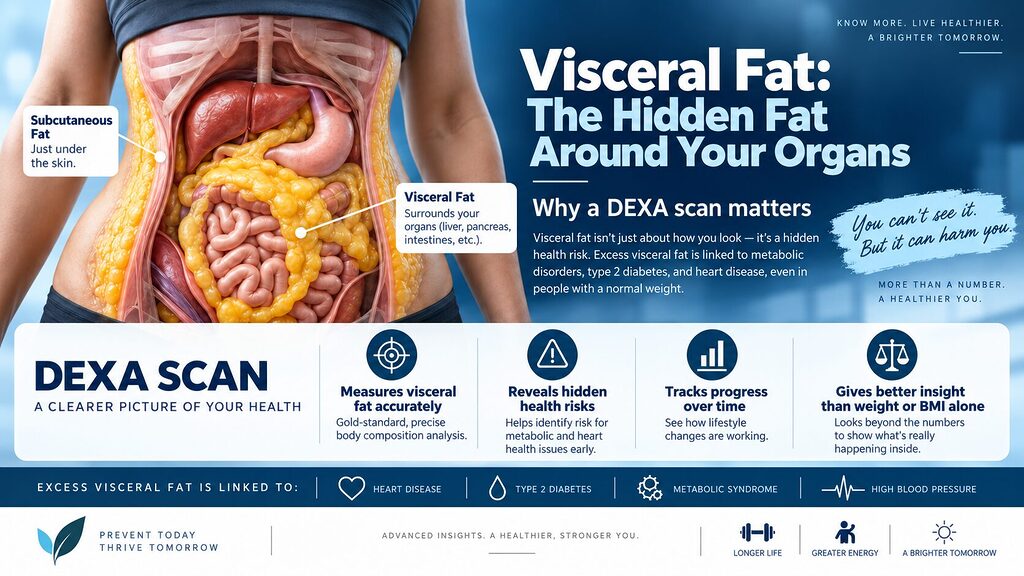
Visceral fat is different from the subcutaneous fat you can pinch under the skin. It is metabolically active and is associated with insulin resistance, type 2 diabetes and cardiovascular risk. Two people can weigh the same yet have very different body-composition profiles, which is why weight alone cannot show where fat is stored.
How Much Visceral Fat Loss May Make a Difference?
The study found that participants who lost 5% or more of their visceral fat were more likely to show meaningful improvements in several health markers than participants who lost no visceral fat.
- Waist circumference: nearly 3 times more likely to show a significant reduction
- HDL cholesterol (“good” cholesterol): more than 4 times more likely to show a meaningful increase
- Triglycerides: around 3 times more likely to show a significant reduction
- HbA1c (a marker of blood sugar control): nearly 3 times more likely to show meaningful improvement
Interestingly, HDL cholesterol also improved in some participants who lost less than 5% of their visceral fat. That suggests smaller changes may still be beneficial, even before a larger target is reached (Abdullah et al., 2025).
Why the Way You Measure Visceral Fat Matters
The study used bioelectrical impedance analysis (BIA) to estimate visceral fat. BIA is convenient and widely available, but it does not image abdominal fat directly. Instead, it estimates body composition from electrical resistance and prediction equations.
When BIA has been compared with CT, one of the reference methods for measuring visceral fat, agreement has been limited. A study of 414 adults found poor agreement between BIA and CT-derived visceral fat measurements (Xu et al., 2021). Another study involving 1,006 adults found that differences between the two methods became greater as BMI increased (Lee et al., 2015).
That does not make the 5% finding unimportant. It does mean that if you are going to track a specific percentage change in visceral fat, the measurement method matters. A target is only useful if the tool can measure the change consistently enough to show real progress.
Where DEXA Fits In
A DEXA body composition scan uses low-dose X-ray technology to quantify body composition, including fat mass, lean mass and an estimate of visceral adipose tissue. DEXA-derived visceral fat measurements have shown strong agreement with CT and MRI in validation research.
In one study of older men, DEXA-measured visceral fat volume correlated strongly with MRI (r = 0.90) and CT (r = 0.83), supporting DEXA as a reliable, low-radiation option for quantifying visceral fat (Cheung et al., 2016). In another study of more than 1,100 older men, DEXA-derived visceral fat showed associations with insulin resistance and HDL cholesterol that were comparable with those seen using CT (Schousboe et al., 2017).
For a broader explanation of what the scan can show, see What a DEXA Scan Actually Tells You About Your Body.
How to Track Your Visceral Fat Loss
A DEXA scan can give you a detailed baseline of your body composition, including body fat percentage, fat distribution, lean mass and visceral fat estimates. Rather than relying only on body weight or waist measurements, you can use that baseline to see what is changing inside your body over time.
If your goal is fat loss, a follow-up scan after an appropriate interval can show whether visceral fat is trending down alongside changes in total fat mass and lean muscle. Based on the 2025 study, a 5% reduction in visceral fat may be a useful progress marker, while smaller improvements may still be meaningful.
The key is to treat the percentage as a tracking target, not a universal medical threshold. Your individual health risks and goals depend on more than one measurement, and results should be considered in the context of your overall health.
Ready to Measure Your Progress?
If you want to understand your body composition and track visceral fat loss with more confidence, book a DEXA scan with MeasureUp at our Sydney or Brisbane labs. Establish your baseline, set a realistic target and track changes using objective body-composition data.
Sources
Abdullah et al., Frontiers in Endocrinology, 2025. https://pubmed.ncbi.nlm.nih.gov/40535330/
Xu et al., BMJ Open, 2021. https://pubmed.ncbi.nlm.nih.gov/34635516/
Lee et al., Nutrients, 2015. https://pubmed.ncbi.nlm.nih.gov/26694460/
Cheung et al., International Journal of Obesity, 2016. https://pubmed.ncbi.nlm.nih.gov/27003112/
Schousboe et al., Journal of Clinical Densitometry, 2017. https://pubmed.ncbi.nlm.nih.gov/28238606/