Hormesis: How a Little Stress Helps You Age Well
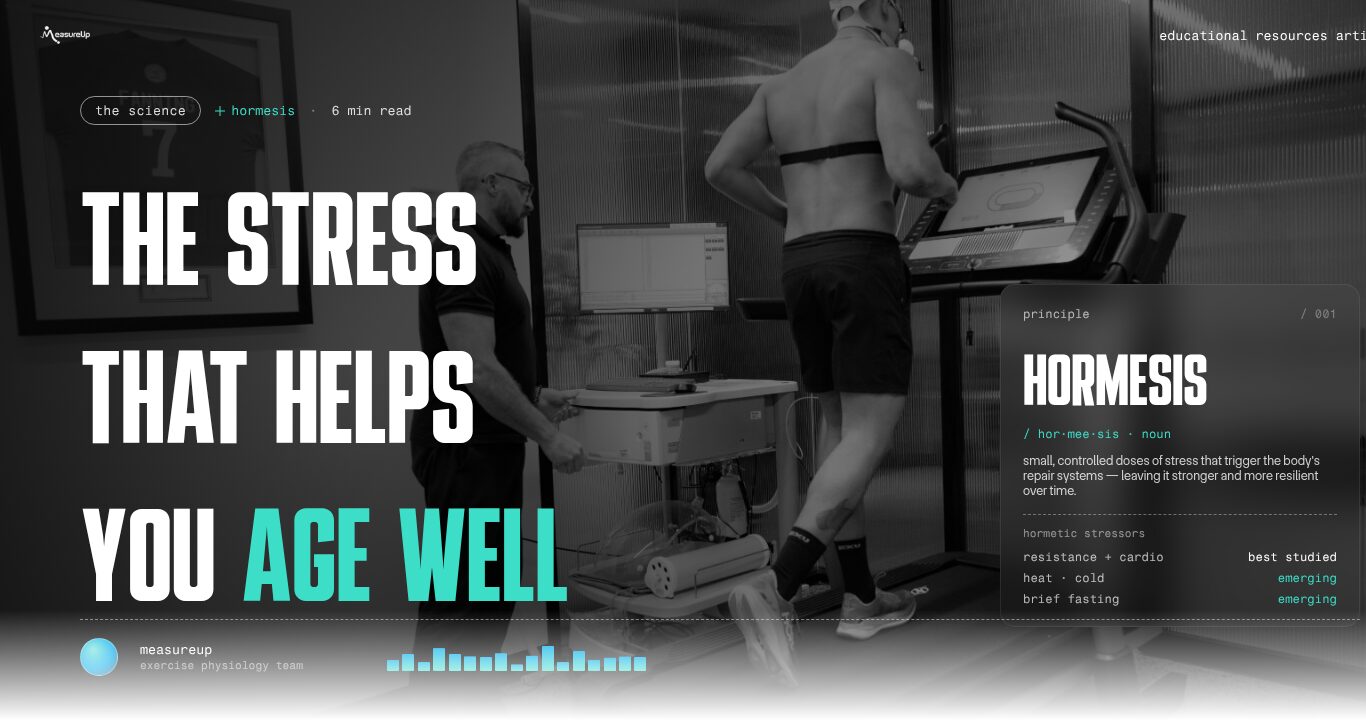
Not all stress is bad. In fact, the right kind of stress might be exactly what your body needs to age well. Hormesis describes a simple but powerful idea: small, controlled doses of stress can push the body to become stronger and more resilient. Rather than causing harm, these mild stressors switch on repair systems that improve how your body works over time. Exercise is one of the clearest examples. When you challenge your body physically, it responds by building stronger muscles, improving heart and lung fitness, and boosting the health of your cells.
Do Sweat It: How Stress Helps at the Cellular Level
At the level of your cells, hormetic stress switches on pathways that help repair damage and keep things in balance. For example, a 2017 review (de Keizer) explains that low-level stress can boost the body’s natural defences, improve how the mitochondria work (the energy systems inside cells), and strengthen the body’s ability to handle future stress. Similarly, newer research suggests that hormesis plays an important role in healthy aging. As a result of these mild stressors, the body switches on repair pathways, becomes more resistant to stress, and builds up less biological damage over time (Calabrese, 2018).
Why Exercise Is the Best Example
Exercise-induced hormesis is especially well studied. When you do resistance or aerobic training, you create short-term stress in your muscles and energy systems. In response, the body adapts by becoming stronger, more efficient, and more resilient. In fact, a recent review in The Journal of Physiology found that regular exercise improves mitochondrial health and slows age-related decline through these very mechanisms (Memme, Erlich, Phukan, & Hood, 2021).
Other Ways to Tap Into Hormesis
Beyond exercise, other lifestyle habits may also act as helpful stressors. For instance, brief exposure to heat (such as a sauna) or cold, along with short periods of fasting, appear to trigger similar effects. While the research is still developing, these habits seem to switch on the same protective pathways that support a healthy metabolism and a longer life (Mattson & Leak, 2024).
Routine Structured Movement: Putting It Into Practice
To make the most of hormesis, focus on adding manageable, consistent stress to your routine. Above all, regular exercise is the most proven approach, so aim for a mix of resistance training and cardio each week. However, the key is balance. On one hand, too little stress leads to no progress. On the other hand, too much can overwhelm your recovery.
Ultimately, the goal isn’t to avoid stress — it’s to use it wisely. When applied in the right dose, stress becomes a tool for building a stronger, more resilient version of yourself.
References
de Keizer, P. L. J. (2017). The fountain of youth by targeting senescent cells? Trends in Molecular Medicine, 23(1), 6–17. https://doi.org/10.1016/j.molmed.2016.11.006
Calabrese, E. J. (2018). Hormesis: Path and progression to significance. International Journal of Molecular Sciences, 21(22), 8571. https://doi.org/10.3390/ijms19102871
Mattson, M. P., & Leak, R. K. (2024). The hormesis principle of neuroplasticity and neuroprotection. Cell Metabolism, 36(2), 315–337. https://doi.org/10.1016/j.cmet.2023.12.022
Memme, J. M., Erlich, A. T., Phukan, G., & Hood, D. A. (2021). Exercise and mitochondrial health. The Journal of Physiology, 599(3), 803–817. https://doi.org/10.1113/JP278853