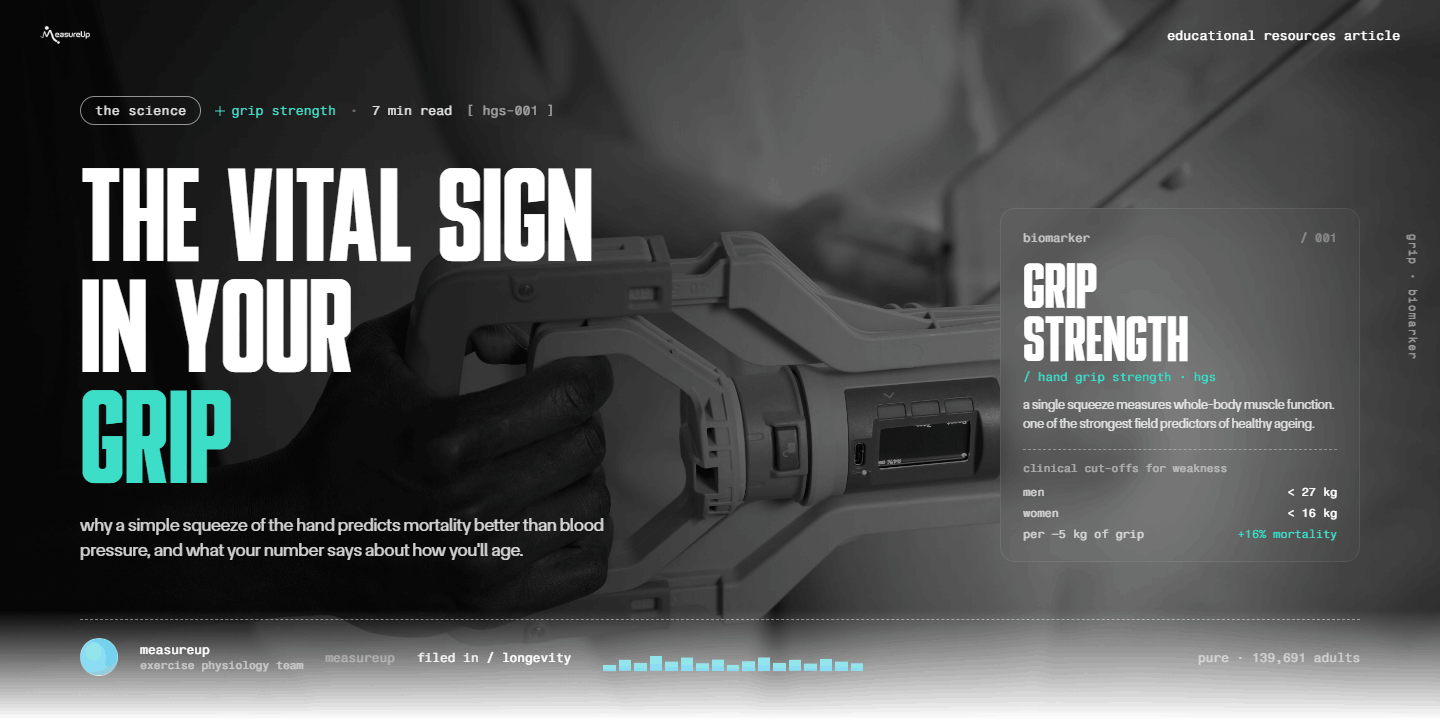
Hand grip strength is one of the most powerful, and most overlooked signs of how well you are ageing. It is a simple squeeze test. Yet decades of research show that your hand grip strength reflects the health of your muscles, your heart and, increasingly, your brain. In fact, doctors now treat it as a genuine vital sign of healthy ageing, much like blood pressure or resting heart rate.
Below, we explain what the science says, what a healthy result looks like for your age, and what you can do if your numbers fall short.
Why hand grip strength predicts your health
A handheld dynamometer measures hand grip strength in kilograms. Because this single number captures your overall muscle function, low grip strength often travels with a range of serious health problems.
All-cause mortality
First, low grip strength raises your risk of early death at any age. For example, the landmark PURE study of nearly 140,000 people across 17 countries found that grip strength predicted early death more strongly than blood pressure. In fact, every 5 kg drop in grip strength carried roughly a 16% higher risk of death, even after the researchers allowed for age, body size, activity levels and chronic disease.
Heart disease
Similarly, each 5 kg fall in hand grip strength carried about a 17% higher risk of dying from heart disease. In addition, weaker grip flagged a greater risk of heart attack, stroke and heart failure.
Muscle loss and frailty
Today, the leading international guidelines (EWGSOP2) treat low muscle strength, rather than low muscle mass, as the main sign of probable sarcopenia, a serious loss of muscle with age. As a result, reduced hand grip strength often points to poorer muscle quality, a decline in everyday function, more falls, disability and a loss of independence.
Hospital and surgery outcomes
Grip strength matters in hospital, too. For instance, people with weaker grip before surgery tend to stay in hospital longer, suffer more complications, recover more slowly and end up back in hospital more often.
Memory and thinking
Finally, researchers also link low hand grip strength to faster mental decline and a higher risk of dementia. Of course, this does not prove that weak hands cause memory loss. Still, grip strength clearly works as a handy marker of how your body is ageing overall.
Normal hand grip strength values by age
Healthy hand grip strength varies by age, sex, ethnicity and the device used. Generally, the most widely cited reference values come from Dodds and colleagues (2014) and Bohannon (2019). The table below shows typical results.
| Age (years) | Male mean (kg) | Female mean (kg) |
|---|---|---|
| 20–29 | 46–52 | 27–32 |
| 30–39 | 45–51 | 27–31 |
| 40–49 | 43–49 | 26–30 |
| 50–59 | 41–47 | 24–29 |
| 60–69 | 38–44 | 22–27 |
| 70–79 | 32–40 | 19–24 |
| 80+ | 25–33 | 15–20 |
What counts as low grip strength?
So how low is too low? The EWGSOP2 thresholds — roughly the weakest 20% of healthy older adults — look like this:
| Sex | Low grip strength |
|---|---|
| Male | <27 kg |
| Female | <16 kg |
In addition, the Asian Working Group for Sarcopenia sets slightly different cut-offs: under 28 kg for men and under 18 kg for women. As a simple guide for healthy adults, you can use the ranges below.
| Category | Men | Women |
|---|---|---|
| Excellent | >50 kg | >32 kg |
| Good | 40–50 kg | 25–32 kg |
| Average | 35–40 kg | 20–25 kg |
| Below average | 27–35 kg | 16–20 kg |
| Clinically low | <27 kg | <16 kg |
Naturally, active people and athletes usually sit well above these norms. For example, male endurance athletes often record 40–55 kg and female endurance athletes 25–35 kg, although this varies widely by sport.
How to improve your hand grip strength
The good news is that hand grip strength responds to training at any age. Here are some practical ways to build it:
- Resistance training: deadlifts, rows, carries and pull-ups work your hands and forearms while building strength all over.
- Direct grip work: hand grippers, dead hangs and farmer’s carries target the very muscles the test measures.
- Plenty of protein: eating enough protein helps you keep and build muscle, especially as you get older.
- Staying active: regular movement guards against the muscle loss that drives a falling grip.
Measuring hand grip strength as part of your health picture
Grip strength gives you a quick snapshot. However, it works best alongside a fuller view of your body and fitness. For instance, a DEXA body composition scan shows how your muscle and fat are spread, a bone density scan checks your skeletal health, and a VO2 max test measures your heart and lung fitness — another strong sign of healthy ageing. Together, these turn a single grip reading into a clear plan.
So if you want solid numbers to track over time, book a scan with MeasureUp and start measuring what matters.
This article is general information only. It is not a substitute for personalised medical advice, so please talk to a qualified health professional before you change your exercise or health routine.